




Overview
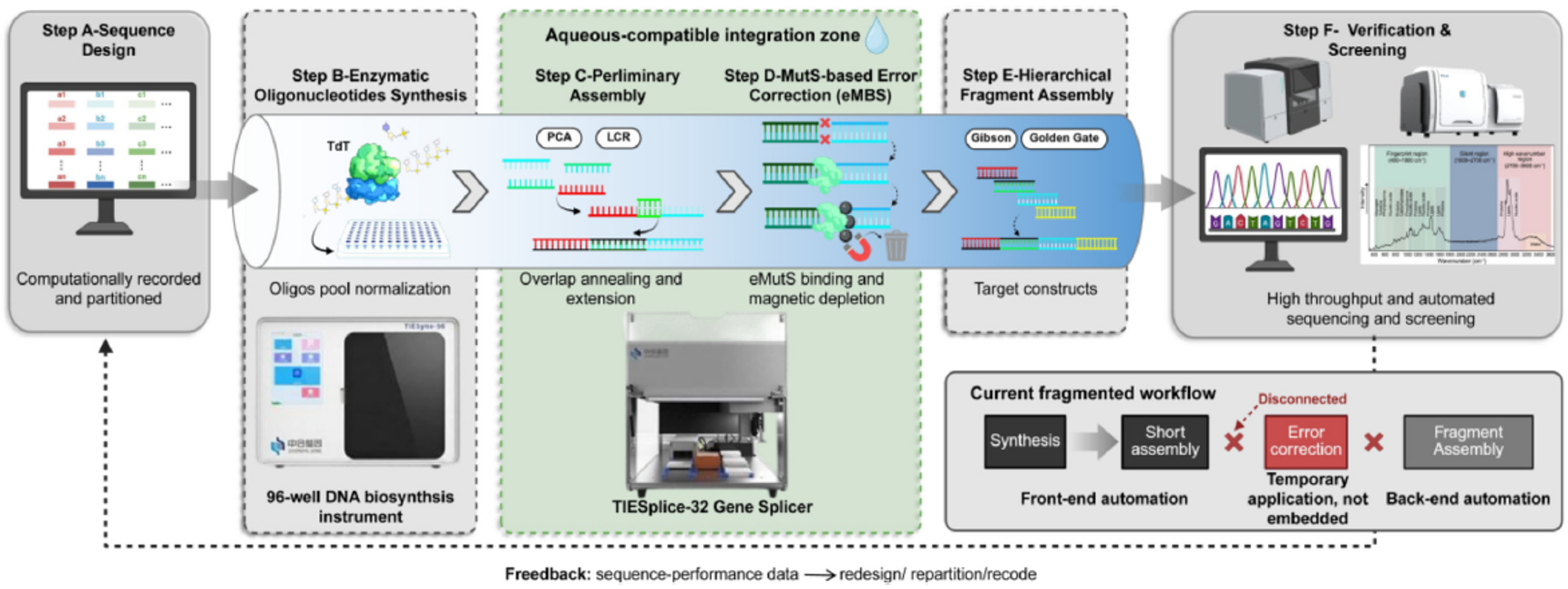
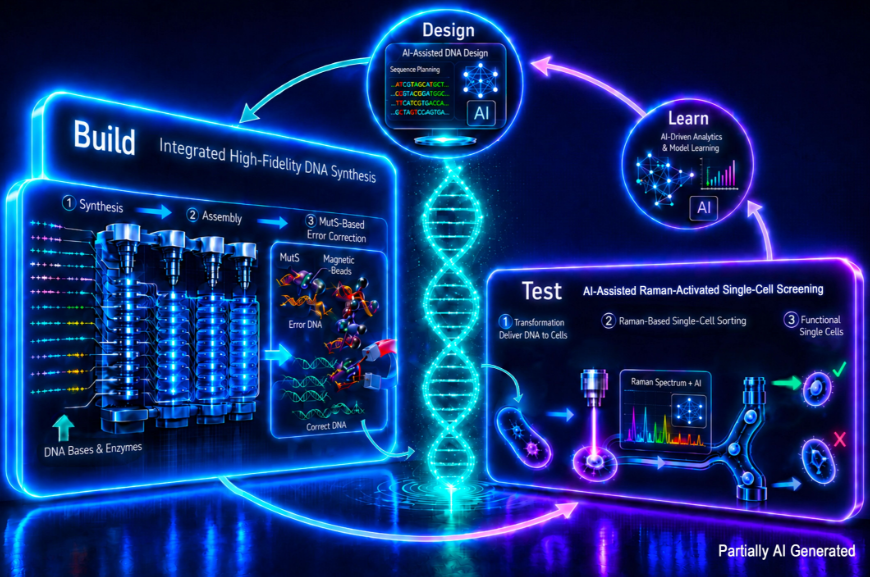
In synthetic biology, scaling from gene-length constructs to pathway- and genome-scale DNA assemblies remains heavily constrained by fragmented workflows. Traditionally, oligonucleotide synthesis, fragment assembly, and sequence error correction operate in silos, allowing synthesis errors to accumulate and driving up the cost and time required for downstream clone picking and terminal sequencing. A recent review published in Biotechnology Advances systematically diagnoses these bottlenecks, and outlines the roadmap for automated, error-aware DNA assembly—positioning eCyte’s single-cell Raman phenotyping as the critical functional screening milestone. The authors propose a unified "Synthesis-Assembly-Error Correction" paradigm and highlight single-cell Ramanome technology as the vital functional screening bridge that connects DNA sequences directly to single-cell metabolic phenotypes within the Design - Build - Test - Learn (DBTL) framework.
Breaking the Fragmentation Bottleneck with Integrated Quality Control
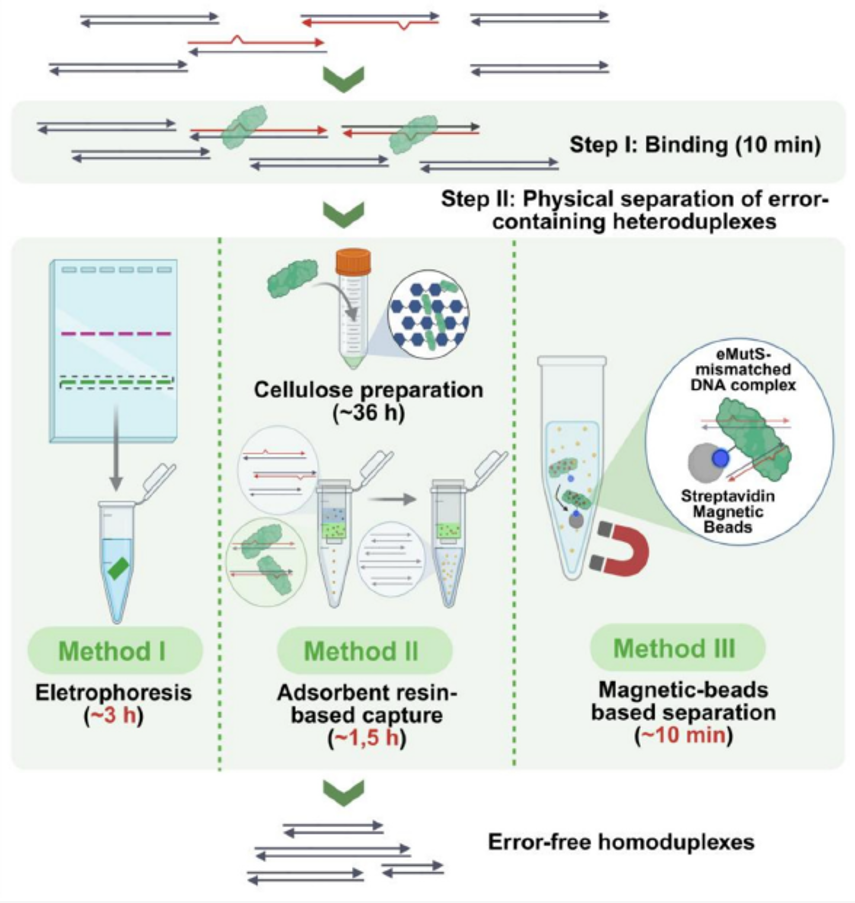
Conventional phosphoramidite chemical synthesis introduces deletion and substitution errors that survive standard HPLC or PAGE purification. When these flawed fragments are amplified and assembled, errors compound, forcing teams to rely on exhaustive clone screening and late-stage sequencing. The review emphasizes transitioning from linear execution to an end-to-end, error-aware workflow. By integrating Enzymatic DNA Synthesis (EDS)—which naturally aligns with aqueous assembly and enzymatic error correction—with MutS protein-mediated mismatch depletion, quality control can be embedded directly into intermediate assembly steps rather than treated as a post-hoc remedy.
Ramanomics: The Final Piece of the Closed-Loop DBTL Cycle
Once high-fidelity long DNA constructs are assembled and transformed, verifying sequence accuracy alone is insufficient; teams must evaluate whether the engineered constructs yield the expected metabolic phenotype inside living cells. The authors highlight single-cell Raman phenotyping and sorting as a transformative terminal screening solution:
Label-Free & Nondestructive Phenotyping: Single-Cell Raman Spectroscopy (SCRS) captures intrinsic molecular fingerprints, providing a real-time metabolic profile of individual living cells without fluorescent staining or cell lysis.
Direct Phenotype-to-Genotype Linkage: By coupling functional single-cell Raman sorting with long-read sequencing and single-cell cultivation, researchers can immediately link target metabolic functions to verified DNA sequences. This avoids the high costs and delays of indiscriminate high-throughput sequencing across unverified clones.
Empowering Advanced Biomanufacturing with eCyte Instrumentation
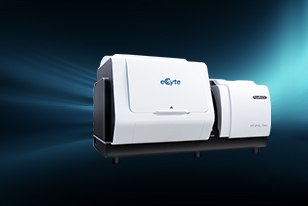
As a pioneer in single-cell Raman instrumentation, eCyte, Inc. provides the core enabling platforms for this next-generation DBTL pipeline:
FlowRACS: High-throughput Raman-activated cell sorting for rapid phenotyping.
RAMS: Microfluidic droplet sorting for high-viability single-cell isolation into 96-well plates.
RACS-Seq: Integrated optical tweezers sorting for seamless single-cell genomics and cultivation downstream.
Together, eCyte’s single-cell analytical suites offer synthetic biologists a standardized, high-throughput phenotyping platform. By transmitting functional metabolic data back to the upstream sequence design module, eCyte helps research institutes and industrial biomanufacturers accelerate the engineering of artificial genetic circuits, cell factories, and genome rewrites. Interested in exploring how single-cell Raman sorting can streamline your synthetic biology pipeline?
Contact us and follow us for more videos on eCyte - YouTube and updates via LinkedIn.