



Overview
Manned deep-space exploration and extraterrestrial base construction urgently require closed-loop material recycling systems, among which biological treatment of extraterrestrial wastewater is a critical bottleneck. Recently, researchers from the Research Center for Eco-Environmental Sciences (CAS), University of Chinese Academy of Sciences, Space Medicine and Medical Engineering Research Center (China Astronaut Research and Training Center), University of Science and Technology of China, and the Institute of Tibetan Plateau Research (CAS) published a perspective review in mSystems. The study proposes utilizing Single-Cell Raman Spectroscopy (SCRS) combined with synthetic biology to engineer functional microbiomes tailored to extraterrestrial extreme environments, opening a groundbreaking technological pathway for Controlled Ecological Life Support Systems (CELSS).

The Reality of Extraterrestrial Water Recycling
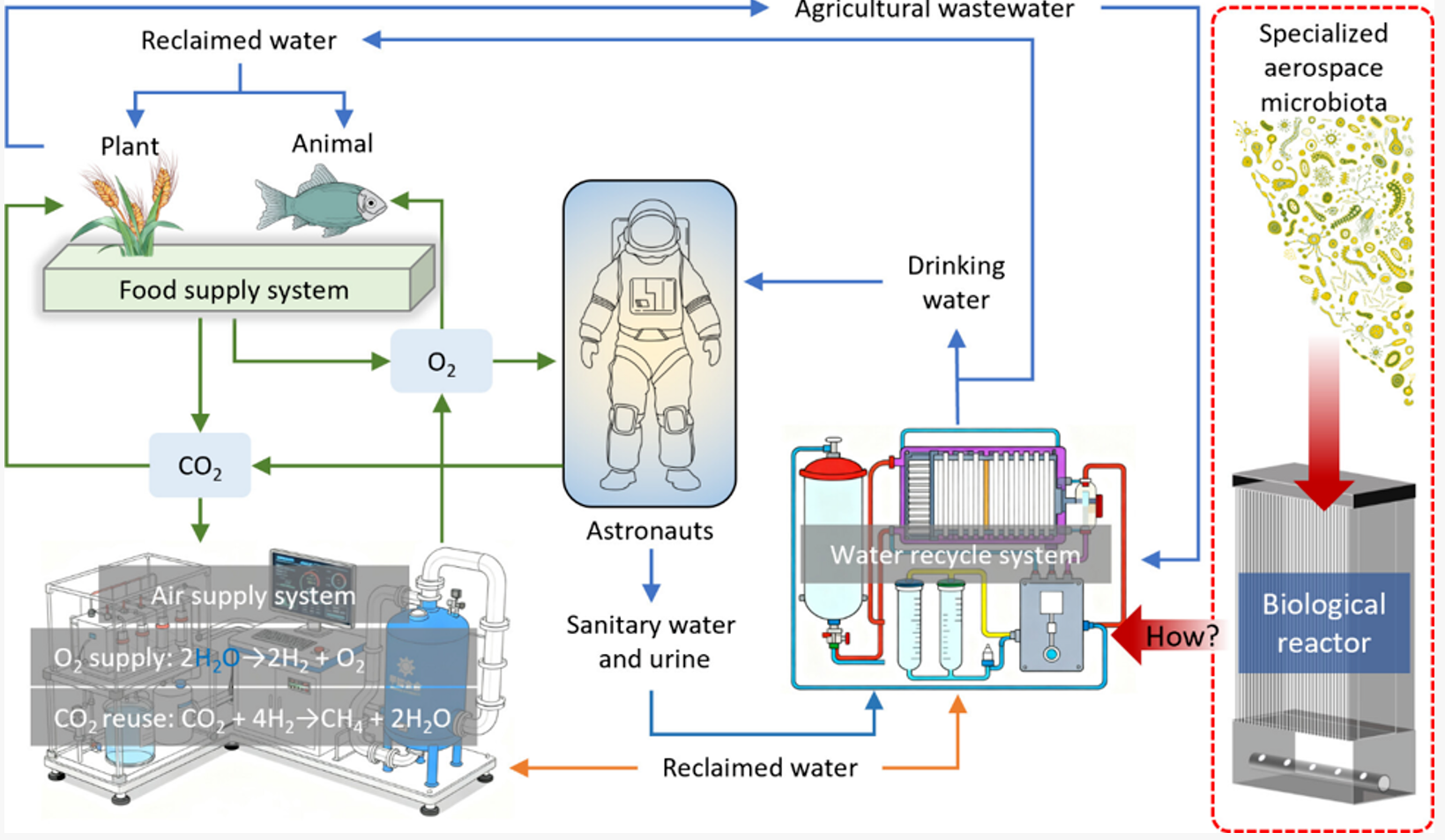
A central challenge in human spaceflight and lunar/Martian base operations is achieving total resource loop closure. Transporting water from Earth involves astronomical costs. Extraterrestrial Domestic Wastewater (EDW)—primarily composed of humidity condensate, hygiene washing wastewater, and urine—presents harsh characteristics: high ammonia-nitrogen, low C/N ratios, acidity, and multiple environmental stressors. Nitrogen removal remains the primary hurdle in processing EDW effectively. Consequently, in-situ water recovery and reuse systems have become indispensable for sustaining long-term space missions.
Synthetic Microbiomes: A Game-Changing Strategy
The paper introduces a bottom-up artificial Synthetic Microbial Community (SynCom) assembly strategy: directly excluding Nitrite-Oxidizing Bacteria (NOB) at the source during community assembly, and selectively assembling Ammonia-Oxidizing Bacteria (AOB), denitrifying functional strains, and auxiliary strains. This bypasses the risk of NOB recovery. However, even in nearly sterile space environments, potential risks persist—including NOB contamination via hardware or crew microbiomes, as well as strain adaptive evolution. Addressing this demands a powerful single-cell platform capable of functional strain discovery, community assembly, and real-time operational monitoring.
SCRS Driving the Full Workflow: From SynCom Assembly to Smart Operations
Traditional screening for stress-tolerant functional microbes relies on prolonged enrichment cultures. For slow-growing autotrophs like AOB, this typically takes weeks or months, often yielding mixed cultures rather than pure isolates and hindering precise SynCom construction. SCRS offers a label-free, non-destructive single-cell phenotyping approach. By analyzing intrinsic cellular molecular vibrations, it generates Raman fingerprints that decode species identity, metabolic activity, and physiological stress status without fluorescence labeling or compromising cell viability.
The article outlines a complete operational workflow:
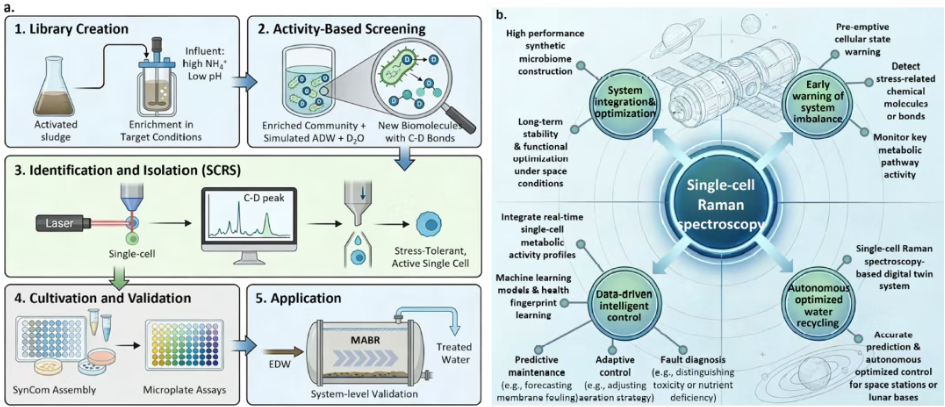
Targeted Mining of Stress-Tolerant Microbes: Inocula are exposed to simulated EDW stress conditions combined with Stable Isotope Probing (heavy water, D2O). Metabolically active cells incorporate deuterium (D) into macromolecules, creating a distinct C-D Raman peak. Using Raman-Activated Cell Sorting (RACS), stress-tolerant AOB and denitrifying single cells are directly captured and cultivated into pure strains, bypassing lengthy enrichment steps.
SynCom Assembly & Validation: Screened functional strains are assembled into synthetic communities, validated for short-cut nitrogen removal at the microplate level, and integrated into Membrane Aerated Biofilm Reactors (MABR) for system-level testing.
On-Orbit Real-Time Early Warning & Intelligent Control: SCRS detects shifts in stress-related molecular Raman peaks to sense physiological anomalies before effluent water quality degrades. Integrated with machine learning, a "Ramanome Health Fingerprint" for SynCom is established, enabling fault prediction, adaptive process regulation, and a digital twin system based on single-cell metabolic data. Furthermore, an NOB Raman fingerprint database enables instant alert triggers upon NOB detection, safeguarding system stability.
Earth Application Spillover: Beyond space scenarios, the "SCRS + Synthetic Microbiome" paradigm applies directly to extreme decentralized wastewater treatment on Earth—such as remote communities or emergency disaster relief camps with limited chemical supplies and energy constraints, enabling low-maintenance closed-loop water reuse.
Ramanomics Empowering Environmental Microbiology
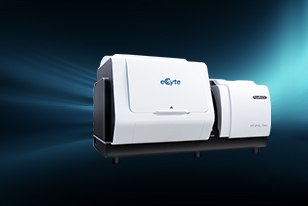
In wastewater biological treatment, this technical framework exemplifies the core paradigm of Ramanomics: non-destructively reading single-cell in-situ metabolic phenotypes to achieve a seamless "Phenotype-to-Cultivation/Sequencing" workflow. Based on Ramanomic principles, eCyte has developed advanced instrumentation including the High-Throughput Flow Cytometric Raman-Activated Cell Sorter (FlowRACS), Raman-Activated Microfluidic Sorter (RAMS), and Raman-Activated Optical Tweezers-based Cell Sorter (RACS-Seq). These platforms enable single-cell metabolic activity identification and non-destructive sorting of live target cells for cultivation or single-cell genomics, overcoming the limitations of unculturable microbes and population heterogeneity.
Contact us and follow us for more videos on eCyte - YouTube and updates via LinkedIn.