




Sunnyvale, CA — eCyte, Inc. is pleased to announce its participation in ASM Microbe 2026, the annual meeting of the American Society for Microbiology, taking place from June 4–7, 2026, at the Walter E. Washington Convention Center in Washington, D.C.
Sino-Micro 2026 Symposium (Circulation 2)
2026 Annual Meeting of the Overseas Chinese Society of Microbiology.
Time: 1:00–4:15 PM, June 4, 2026
Venue: Room 146C
Featured Session 2: Frontiers in Microbial Metabolism and Systems Monitoring
2:00–2:25 PM Presentation
Establishing A Global Network of Microbial Metabolic Observatories via the iMAPS Consortium
Jian Xu, Director, Single-Cell Center; Director, Advanced Biomanufacturing Division
Qingdao Institute of BioEnergy and Bioprocess Technology (QIBEBT), Chinese Academy of Sciences
2:25–2:50 PM Presentation
The Ramanomics Instruments for Profiling and Sorting Microbial Metabolism
Ethan Yin, Chief Scientist, eCyte Inc.
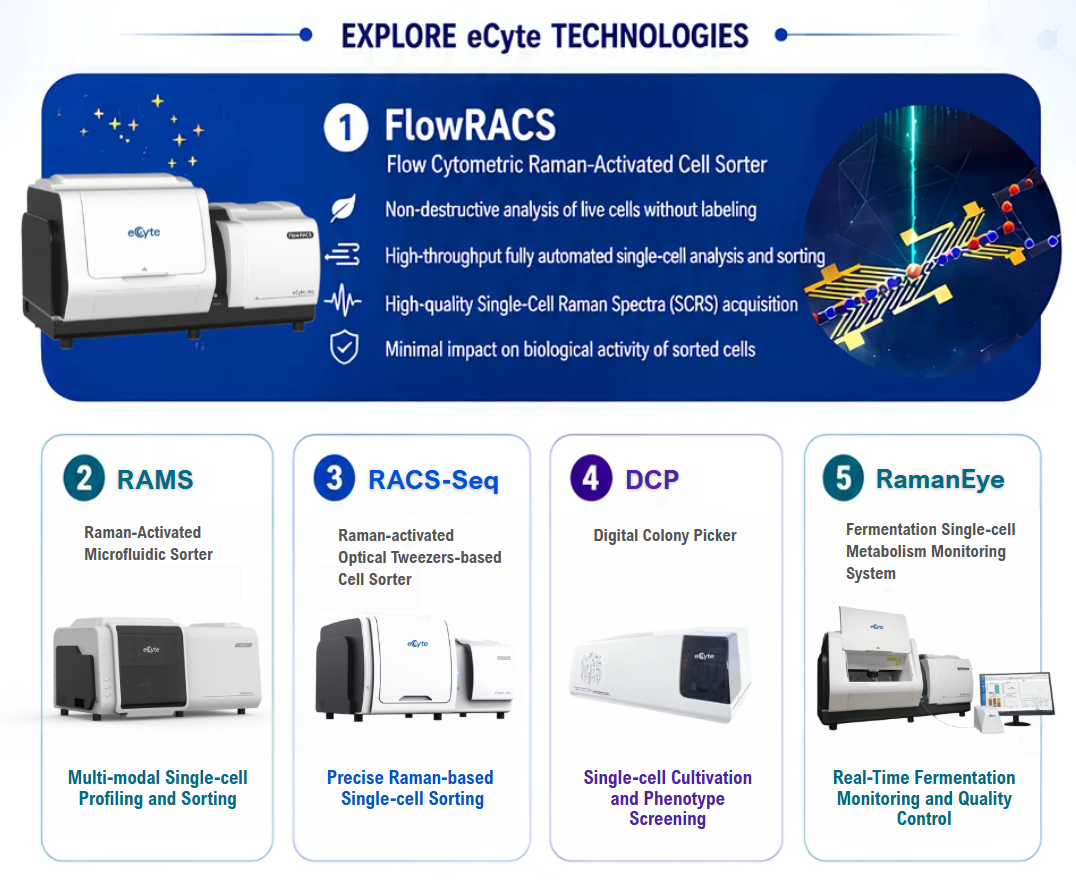
Dr. Yin’s presentation will introduce eCyte’s Ramanomics instrument technologies and their applications in microbial metabolism profiling and sorting. By combining Raman spectroscopy, high-throughput single-cell analysis, and advanced sorting workflows, these platforms are designed to help researchers connect microbial phenotypes with metabolic functions in a label-free and function-first manner.
Showcasing eCyte’s Single-Cell Technology Portfolio
Advancing Function-First Microbiology
eCyte’s participation in ASM Microbe 2026 reflects its commitment to enabling the next generation of microbial science. By providing technologies that analyze and sort cells based on their real-time metabolic states, eCyte aims to help researchers move beyond population-level measurements and uncover functional heterogeneity at single-cell resolution.
eCyte looks forward to engaging with researchers, clinicians, and industry partners at ASM Microbe 2026 and the Sino-Micro 2026 Symposium to advance discussions on single-cell Ramanomics technologies for microbial metabolism research and functional screening. Through its participation, eCyte aims to further support the development of function-driven microbiology and global single-cell observatory networks.